
What is Sustainable Development?
Early concepts
Original framings of sustainable development can be found in Indigenous ontologies, which practise respect and reciprocity, whilst recognising humans as inseparable from nature. However, the term was first articulated specifically in the 1987 Brundtland Report, Our Common Future, which proposed the need to integrate Economic, Social and Environmental dimensions in order to achieve fair and long lasting development. The report initially defined Sustainable Development as:
“… development that meets the needs of the present without compromising the ability of future generations to meet their own needs”
The subsequent 1992 Earth Summit laid the foundations for current Conference of the Parties (COPs) on Biodiversity and Climate Change and provided an overarching declaration on the principles of sustainable development, along with an implementation plan, Agenda 21. This plan promoted participation by all and emphasised the need for local and community contributions.
The Sustainable Development Goals
A succession of different global summits continued to progress these ideas. By 2000, it was realised that specific global development goals would increase accountability and enable monitoring. The Millennium Development Goals (MDGs) were launched, but they were focused mainly on development, especially through aid, in the Global South, and they prioritised human needs. Following lessons learnt from working towards the MDGs, global priorities were reassessed and a new suite of internationally-agreed development goals, the SDGs, was launched in 2015, after extensive consultation with more than 7 million people across different sectors.
The rationale for the SDGs is explained in Transforming our world: the 2030 agenda for sustainable development. This document beautifully articulates aspirations for nobody to be left behind, and for dignity for all, whilst proposing an action plan with 169 targets and accompanying indicators. The SDGs offer a holistic vision and emphasise the breadth and interdependence of different aspects of sustainable development. For example, actions on poverty can often be aligned with actions on climate change or biodiversity, but there can sometimes be tensions between environmental goals and some development goals. The SDGs also pursue objectives for peace, partnership and participation. They are universal, requiring action within every country and sector, as well as globally.
Since their launch in 2015, they have slowly been taken up by many actors, including governments, local authorities, civil society, businesses and education institutions. They now present a common language for discussion of sustainable development action and a shared suite of indicators by which to assess progress towards targets. There has been much theorisation of sustainable development, yet these debates are useful for to ensure that the scope and interrelationships of different goals are not lost.
Contemporary practices of Sustainable Development
The SDGs have shifted us from human centred to nature respecting andfrom needs to rights. There is now more focus on equity and inclusion, and dignity for all, with no harm to planet; recognising the rights for choice, freedom and agency by poor or marginalised peoples. Rather than highlighting separate Social, Economic and Environmental dimensions, many frameworks now emphasise systems thinking, relationality and policy coherence.
One widely used model of Sustainable Development, known as doughnut economics, combines the notion of the planetary boundaries that we must not overstep with a social ceiling below which we must not fall, indicating the safe and healthy limits within which we can survive and thrive (Raworth 2012). However, other frameworks are also used.
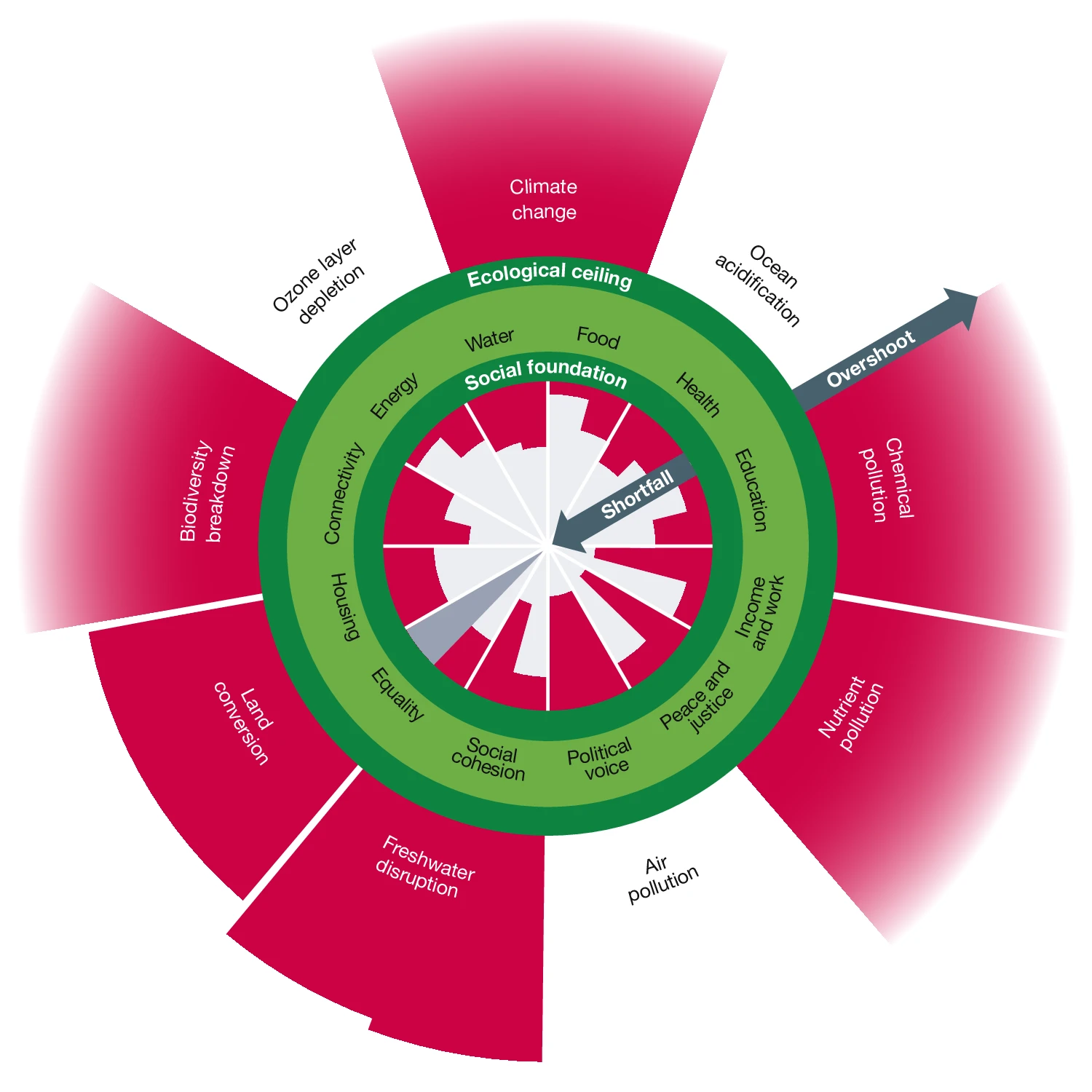
https://doughnuteconomics.org/news/doughnut-3-0-is-here
A Scottish Definition of Sustainable Development?
There are therefore many definitions and understandings of sustainable development. In some ways this impedes shared understanding and action, but providing the principles are broadly understood, allowing people to identify with sustainable development definitions in context can be very powerful. The SDG Network Scotland suggest the following definition:
“Sustainable development is development that recognises the rights and wellbeing of people and nature in Scotland and globally; without compromising those of future generations and places”
At this time the Scottish Government is reassessing how it integrates Sustainable Development within its activities, as a part of National Outcomes monitoring. SDG Network Scotland strongly believe that the rights of people and nature should be central to all parts of governance.
What does Sustainable Development mean locally?
Communities can create Voluntary Local Reviews (VLRs), which map their progress and actions at a local level, whilst organisations will often produce sustainability reports for their stakeholders. These often focus on strategic priorities and measurement, but can be used as frames for practical action.
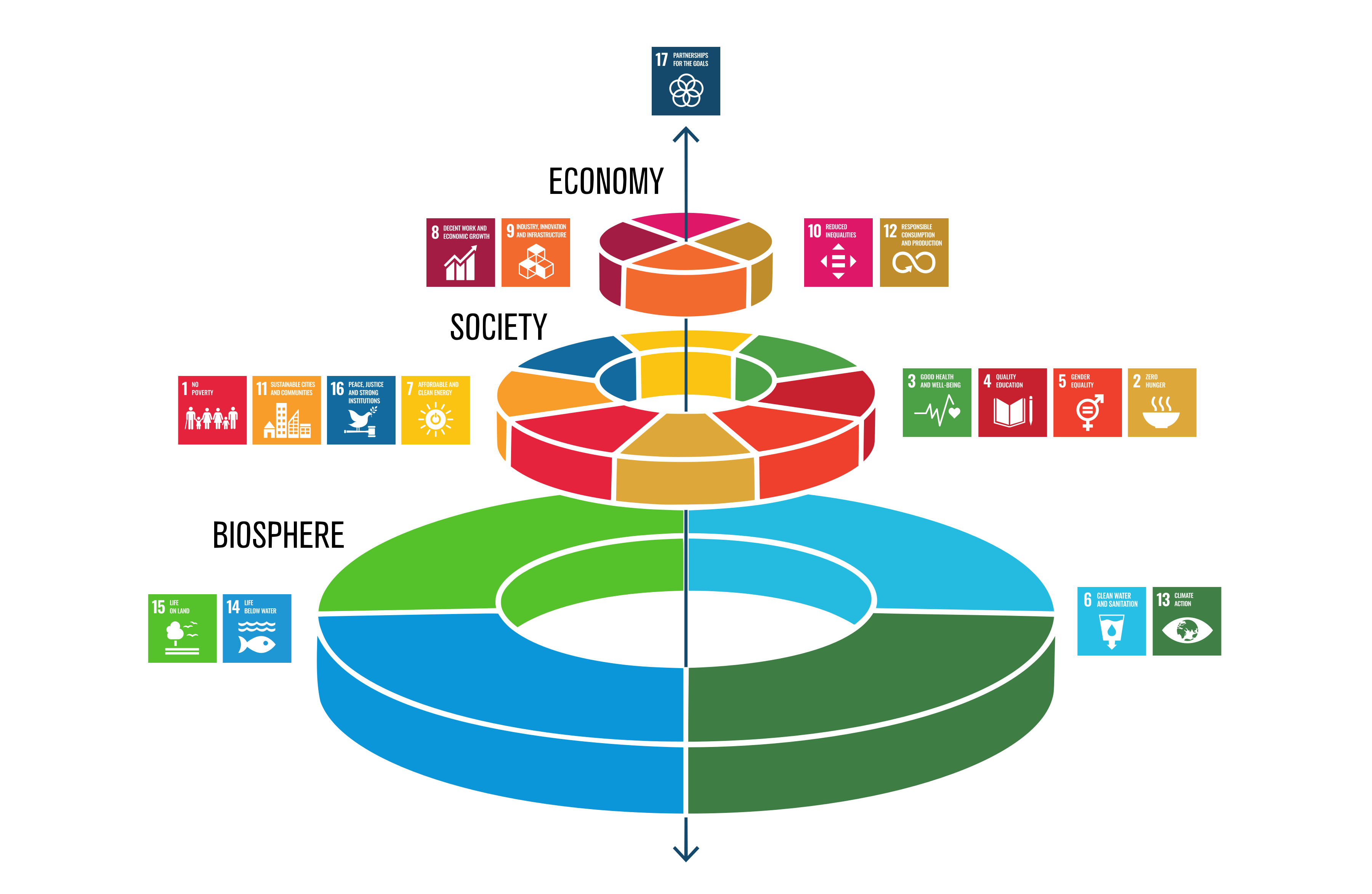
If you group the 17 SDGs, you will find a significant number are related to inequalities or insecurities in society, but that these are embedded and dependent upon nature and planetary boundaries. Acting on sustainable development is ensuring that these different aspects are considered within economic or social development.
There are approximately 10 targets per goal, adding up to 169 in total:
Collaboration is therefore important to ensure knowledge and expertise across areas is well understood, but also that some measures will be less relevant in some circumstances.
Each of these targets has more detailed measures, whilst further ‘disaggregation’ of measures, for example how location, race, gender or ethnicity impact targets, is a key aspect of measurement.
The UN has collated advice on VLR development, which can help to put these frameworks into practice. Learning for Sustainable Development Scotland also provide resources that support further learning about sustainable development, whilst SDG Network Scotland also share events and resources to support action towards more sustainable development.
Learning for Sustainability Scotland
Scotland’s Regional Centre for Expertise on Education for Sustainable Development works to make sustainability part of the everyday for all learners and educators.
SDG Academy
These free online courses can provide excellent primers in more detailed topics around sustainable development;